

How to Analyze Your CS2 Matches Like a Coach, Not a Casual Player
 3
3
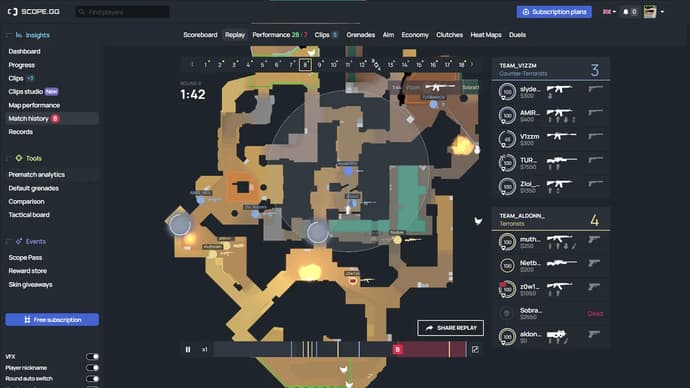
Most players analyze their CS2 matches very superficially — they look at K/D, ADR, or just watch highlights. This approach creates an illusion of understanding the game but doesn’t actually answer the key question: why rounds were won or lost. As a result, mistakes repeat and progress stalls.
That’s why coach-style CS2 match analysis focuses not on stats, but on decision-making. This approach helps identify recurring issues in timing, positioning, utility usage, trading, and rotations — the factors that actually determine the outcome of a round.
Effective CS2 match analysis is built around a step-by-step breakdown of each round, followed by validating patterns through heatmaps and timelines. This is where tools like scope.gg become especially useful, as they clearly visualize player behavior throughout a match and help quickly identify key mistakes.
Where Pro Match Analysis Starts
Why do we lose retakes/ mid control/ late rounds? That’s the question any analysis should start with if you want to think like a coach instead of just looking at numbers.
Instead of jumping straight into stats, focus on specific in-game situations where your team loses control of the round.
Then select 4–5 key rounds — close clutches, turning points, or force/eco rounds that affected the economy and tempo. These rounds reveal real problems best because every decision carries more weight.
Next, form a simple hypothesis, for example:
“We rotate too late because we lack information.”
This gives direction to your analysis — you’re no longer just watching a demo, you’re testing an idea.
While reviewing rounds, pay attention to:
- when the team gains information
- how quickly it reacts
- whether decisions could have been made earlier
In most cases, you’ll notice repetition: either information isn’t gathered, is ignored, or comes too late. That’s how random mistakes turn into systemic patterns.
Data That Measures Decision-Making, Not Mechanics
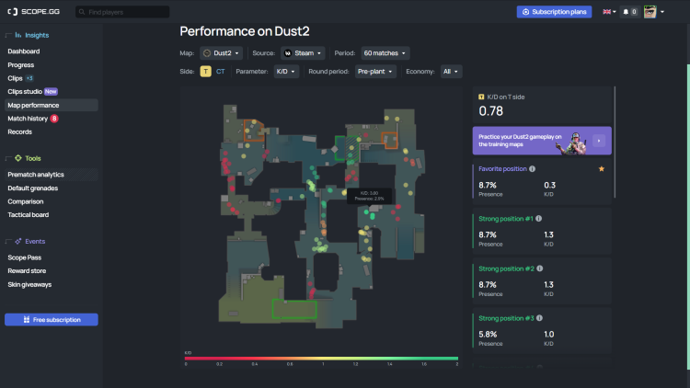
Most players focus on mechanical stats — K/D, ADR, headshots. But these numbers say almost nothing about decision quality. To actually improve, you need to analyze not how you shoot, but why you end up in certain situations. That’s where scope.gg is useful — timelines and heatmaps help identify decision-making mistakes, not just aim issues.
Key aspects to analyze:
- Timing
When does first contact happen? Are you entering too early without support, or too late when positions are already taken?
- Positioning
Where do you die? Open or isolated positions usually mean lack of support.
- Utility usage
Every grenade should create value: space, information, or pressure. Random usage = wasted resources.
- Trading & spacing
Is your teammate close enough to trade within ~2 seconds? If not — you’re isolated.
- Economy
Does your buy make sense not just now, but for the next two rounds?
Mini-table: signals and meaning
| Signal | What it means | How to fix |
| Early deaths without team contact | Poor timing or lack of support | Sync entries, wait for flash or info before engaging |
| Deaths without trade | Bad positioning or spacing | Play closer to teammates, avoid isolated angles |
| Utility has no impact | Lack of intent | Use utility with a clear purpose (space, info, force movement) |
| Team reacts too slowly | Late rotations or poor communication | Share info earlier, make faster decisions |
| Force/eco rounds without a plan | Poor economy management | Plan buys for the next 2 rounds |
This approach turns vague “mistakes” into clear signals.
Round-by-Round: How Patterns Actually Show Up
Step-by-step round analysis helps reveal patterns you won’t see in stats.
Take 4–5 key rounds and assign one main issue per round (info, timing, positioning, utility, trading, rotations, economy). Then identify which tags repeat most — that’s your core problem.
Core rules:
- Info: If you lack clear information by ~1:05, actively create it (take mid, use utility, apply pressure).
- Timing: Avoid delaying key actions into the last 20–25 seconds without map control and prepared utility.
Example:
- Casual view: “We lost because we didn’t enter and lost duels.”
- Coach view: No info or mid control by 1:00, no pressure applied. Execute starts with 18 seconds left and no utility.
Tags: info + timing
Why Heatmaps + Timelines Beat Overall Numbers
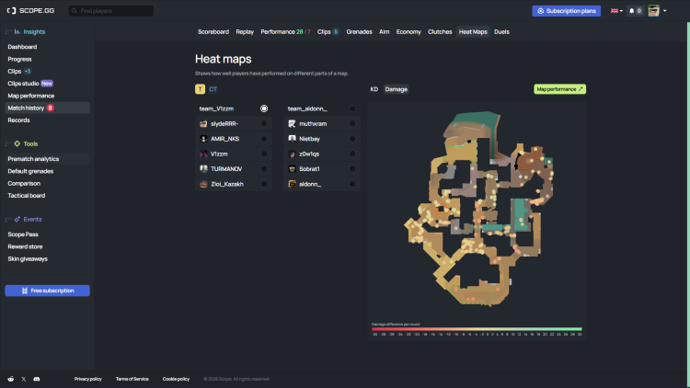
Overall stats like K/D or ADR only provide a surface-level view of the game. They can show what went wrong, but almost never explain why it happened. That’s why, for deeper CS2 match analysis, tools that provide context — heatmaps and timelines — are far more valuable.
Heatmaps show where problems occur. For example, if most of your deaths happen in the same areas, it’s a clear sign of a recurring mistake. These could be first-contact positions where you consistently lose duels, or tight corridors where you often die without a trade. Such patterns are hard to spot through raw stats, but immediately stand out on a heatmap.
Timelines, on the other hand, answer when a round starts to fall apart. An early unsupported peek can trigger a domino effect, causing the team to lose map control. Mid-round delays often indicate a lack of information or a clear plan. A rushed late-round execute is usually the result of poor timing. Timelines make it easy to see these moments and understand the cause-and-effect behind them.
Together, these tools provide a complete picture: heatmaps show where, and timelines show when the problem occurs. This makes it easy to validate your earlier hypothesis — for example, whether late rotations are actually caused by a lack of information.
This is where scope.gg becomes especially useful, as it combines these tools in one place. In just a few minutes, you can confirm your observations: identify frequent death zones, check timing of engagements, and understand exactly where the round slips out of control. It’s much faster and more effective than relying on stats alone.
Individual Mistakes vs Team System Problems
One of the key aspects of CS2 match analysis is understanding whether an issue comes from an individual player or the team as a whole.
An individual mistake occurs when one player consistently repeats the same issue — dying without a trade, misusing utility, or taking isolated positions. In this case, the focus should be on improving that player’s decisions and role.
A system problem happens when multiple players make the same mistake — lack of trades, late rotations, unsynchronized utility, or chaotic buys. Here, the issue lies in team protocols and communication.
How to identify it quickly:
- If the mistake repeats in one player → individual
- If it appears across multiple players or rounds → system
Checklist:
- Information
- Trading
- Plan
- Timing window
- Repetition
- Role clarity
This approach helps you understand not who is to blame, but what needs to be fixed.
Conclusion
What does improvement in CS2 start with? Not with statistics, but with proper analysis. Pick a few key rounds, break them down step by step, and identify the main mistake in each. Instead of focusing on K/D or ADR, pay attention to what repeats — these patterns directly impact decision-making and match outcomes.
Then move to action: choose 1–2 of the most common mistakes and turn them into simple rules for your next games. This is what makes your progress consistent rather than random.
Scope.gg is a tool that helps you analyze your CS2 matches faster and more clearly, so you can identify patterns and fix them effectively.

Kateryna Prykhodko on luova kirjoittaja ja luotettava EGamersWorldin toimittaja, joka on tunnettu mukaansatempaavasta sisällöstä ja yksityiskohtien huomioimisesta. Hän yhdistää tarinankerronnan selkeään ja harkittuun viestintään, ja hänellä on suuri rooli sekä foorumin toimituksellisessa työssä että kulissien takana tapahtuvassa vuorovaikutuksessa.

 Kuinka avata kaikki Crimson Desertin korjauksessa 1.01.00 lisätyt ratsitCrimson Desert Patch 1.01.00 lisää viisi pysyvää legendaarista ratsua. Näin avaat ne kaikki.
 vitaliiD
 VCT 2026: EMEA-vaiheen 1 yleiskatsausAmmattimainen VALORANT-kausi EMEA-alueella jatkuu VCT 2026: EMEA Stage 1:llä, joka on ensimmäinen merkittävä alueellinen vaihe Kickoff-tapahtumien jälkeen.
 stawraith
 Legendaarinen Silver Fang -suden pysyvä ratsu Crimson Desertissä: Kuinka päästä sinneCrimson Desertin legendaarisen Silver Fang -ratsun opas: sijainti, tehtävävaatimukset, tiedot ja edut.
 Dima Ostapchuk
 Höyrystin ARC Raidersissa: Yleiskatsaus uuteen ARC:iin Flashpoint-päivityksessäHöyrystin on nopea ja lentävä ARC-vihollinen ARC Raidersin Flashpoint-päivityksessä, joka lisää haastetta ja vaihtelua raideihin.stawraith